
Episode 1 · 1985–2010 · 7:03 min
The $50 million "no": how Blockbuster destroyed itself
Blockbuster wasn't blind. It saw the future, built it, and came close to killing Netflix. What brought it down was something else.
September 5, 2026 · Leer en español
In 30 seconds
- In September 2000, Netflix offered itself to Blockbuster for $50 million. CEO John Antioco struggled not to laugh.
- Four years later that same Antioco launched Blockbuster Online and, in 2006, Total Access, the one weapon Netflix could not copy.
- In the second quarter of 2007 Netflix lost 55,000 subscribers, the first decline in its history. Hastings later admitted that without Blockbuster's debt, "they would have killed us."
- What killed Blockbuster was a billion dollars of debt inherited from Viacom, an activist investor in a hurry, and a fight over a $7.6 million bonus that pushed out the only CEO who understood the transition.
- One store remains, in Bend, Oregon. Netflix is worth about $417 billion.
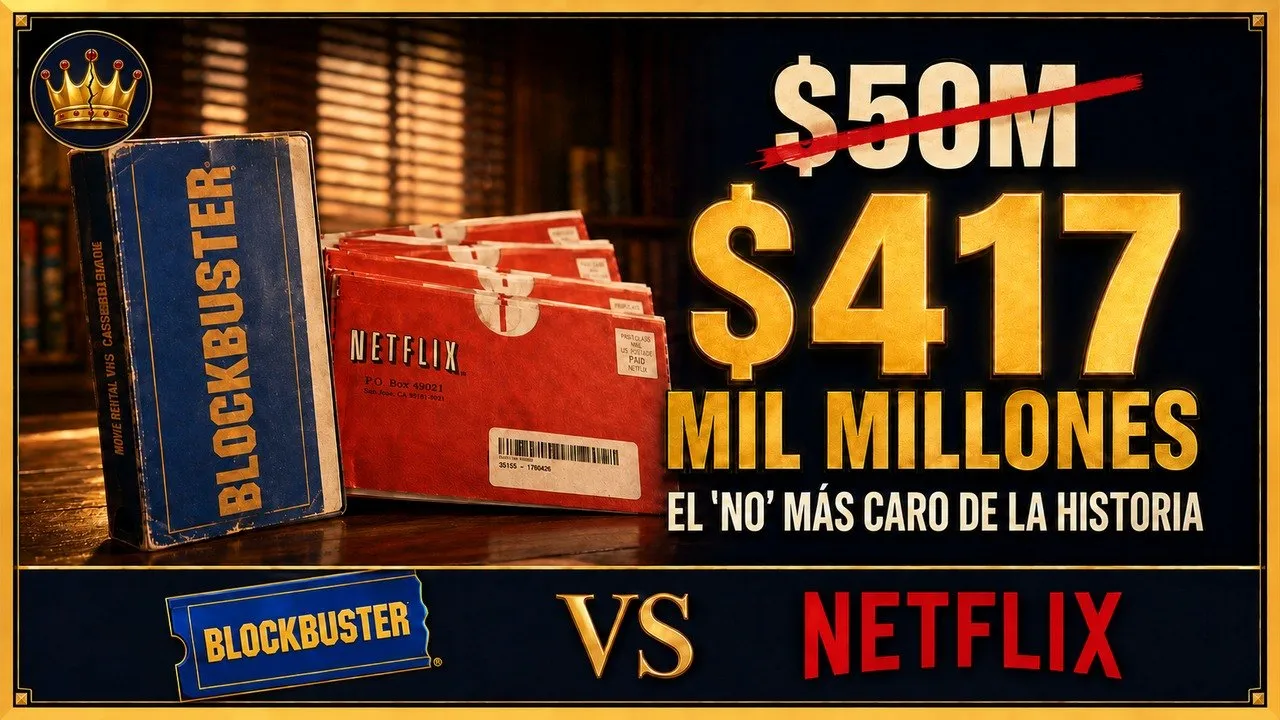
In 2000, three men boarded a chartered jet at five in the morning and flew to Dallas. Reed Hastings, Marc Randolph and Barry McCarthy had a meeting at the headquarters of Blockbuster, the largest movie-rental chain in the world. They were there to offer their company, Netflix, for $50 million.[1] Across the table, CEO John Antioco heard the number and, as Randolph remembers it, had to keep from laughing.
That “no” weighs more than $417 billion today, Netflix’s valuation in 2026.[3] It is easy to tell this as the story of the dinosaur that never saw the meteor coming. It is also the wrong version. Blockbuster saw the future, built it, and had Netflix on the ropes. What destroyed it was something else.
The empire and its dirty secret
Blockbuster was born in Dallas in 1985, when David Cook, a software engineer, opened a video-rental store unlike anything that existed: huge, bright, family-friendly. Wayne Huizenga bought a stake two years later and applied the McDonald’s formula: standardize and multiply. By 1994, Viacom paid $8.4 billion for the chain.[4] At its peak it had more than 9,000 stores and 84,000 employees.
That number is the seed of everything that follows. Every late fee was a customer wishing someone would rescue them.
The rival that attacked exactly there
In California, in 1997, Hastings and Randolph founded a company with an odd idea: renting DVDs by mail. Legend says it was born of a $40 late fee on Apollo 13. That was marketing, and Randolph has said as much. But the enemy they chose was real. In 1999 Netflix changed the rules of the business: a flat subscription, no due dates, no late fees.[5] It attacked precisely the spot where Blockbuster made $800 million a year.
By September 2000 the dot-com bubble had just burst and Netflix was bleeding cash. That is why they were in Dallas. Hastings’s proposal was concrete: you run the stores, we run the online business. Antioco’s answer went down in history: the dot-com hysteria was completely overblown.[1] “They laughed us out of the office,” Netflix’s CFO would recall years later.[2]
That is where the story everyone knows ends.
The dinosaur strikes back
Start with what nobody said out loud that day. Antioco had not said no to the internet. Two months earlier, Blockbuster had signed a twenty-year deal with Enron to stream movies into homes.[6] The deal lasted eight months: the studios would not release the rights, and Enron was headed for the most scandalous bankruptcy in history. Blockbuster wasn’t blind. It picked the wrong partner.
In 2004, Antioco did something villains do not do: he admitted his mistake. He launched Blockbuster Online and signed up a million subscribers in its first year.[5] And in November 2006 he launched the weapon Netflix could not copy: Total Access. Rent online, swap the disc for free at any of 9,000 stores. Online plus physical stores. Netflix only had the first half.
Hastings would later admit it in a sentence worth keeping: “If it hadn’t been for their debt, they would have killed us.”
What debt?
When Viacom spun off Blockbuster in October 2004, it sent it into the world carrying close to a billion dollars of debt.[4] And Total Access cost a fortune. Blockbuster was winning the war while bleeding out.
Then came the character who actually kills Blockbuster, and it is not Reed Hastings. It is Carl Icahn, the activist investor. In 2005 he bought about 10 percent of the company and took three board seats. He did not want a ten-year transition; he wanted the stock up now.[5]
The ending is almost absurd. In 2007, Icahn and Antioco fell out. Not over strategy, but over a $7.6 million bonus. Antioco negotiated his exit and left. He was replaced by Jim Keyes, the former CEO of 7-Eleven, a store operator with no digital experience. Keyes cut the online investment, raised Total Access prices and doubled down on physical stores. With Netflix on the ropes, Blockbuster dropped its gloves and turned around.
Free fall
The rest came fast. In 2007 Netflix launched streaming. In 2008 the financial crisis shut off credit; Keyes himself described the impossibility of raising money as the death blow. In 2010, desperate, Blockbuster brought back late fees: the perfect symptom of a company that no longer knew what it was.[5]
The last 300 corporate stores closed in January 2014. Today exactly one Blockbuster is left in the world, a franchise in Bend, Oregon, that lives off selling nostalgia.[7] Netflix closed 2025 with more than $45 billion in revenue.[3] The $50 million it asked for in Dallas is now about 0.01 percent of its value.
The final irony
The fight that pushed Antioco out was over $7.6 million, a tiny sum next to what was at stake. Icahn himself admitted years later that it had been the worst investment of his life, and that the board may have been wrong to replace him. Antioco, for his part, put his severance into Netflix stock.[5]
Blockbuster saw the future, built it and held it in its hands. It did not survive itself.
What the official story skips
That Antioco never said no to the internet. Two months before the Dallas meeting, Blockbuster had signed a twenty-year deal with Enron to stream movies into homes. It lasted eight months, the studios never released the rights, and Enron was headed for the most scandalous bankruptcy in history. Blockbuster wasn't blind. It picked the wrong partner.
Sources
Everything this episode claims comes from here. Bracketed numbers in the text point to this list.
- 1.
article · Inc. · Minda Zetlin
Netflix cofounder Marc Randolph on the Blockbuster meeting
Used in: H1, E11, E12
- 2.
article · Fortune · 2023-04-14
Netflix cofounder Marc Randolph recalls Blockbuster rejecting the chance to buy it
Used in: H1, E12
- 3.
- 4.
- 5.
article · CNBC · 2020-09-22
How Netflix almost lost the movie rental wars to Blockbuster
Used in: E08, E09, E10, E13, E14, E15, E16, E18, E24a, E24b, E24c
- 6.
article · Inc. · 2018
How early streaming video led to the unraveling of the Enron scandal
Used in: E12b
- 7.
- 8.
report · SEC EDGAR / Netflix · 2007-07-23
Netflix Announces Second-Quarter 2007 Financial Results (Exhibit 99.1)
Net subscriber change in the quarter was a decrease of 55,000
Used in: E15
Images
- Storefront of the last Blockbuster, Bend, Oregon: Foto: UpdateNerd, CC0, vía Wikimedia Commons · color graded to match the channel
- The last Blockbuster from the lawn, Bend, Oregon: Foto: UpdateNerd, CC0, vía Wikimedia Commons · color graded to match the channel
- Red Netflix DVD mailing envelope: Foto: Marit & Toomas Hinnosaar, CC BY 2.0, vía Wikimedia Commons · color graded to match the channel
- Netflix return envelope with the DVD: Foto: Marit & Toomas Hinnosaar, CC BY 2.0, vía Flickr · color graded to match the channel
Episode transcript
The $50 million 'no'
H1In the year two thousand, three men offered to sell Netflix to Blockbuster. The price: fifty million dollars. The CEO… held back a laugh.
H2That "no" is worth four hundred and seventeen billion dollars today. The most expensive mistake in modern business history.
H3But the story you were told is a lie. Blockbuster wasn't blind. It saw the future, it built it… and it came within inches of killing Netflix. This is what really happened.
The empire
E05Nineteen eighty-five. Dallas. David Cook, a software engineer, opens a different kind of video store: huge, bright, family-friendly. He calls it Blockbuster.
E06Wayne Huizenga applies the McDonald's formula: standardize and multiply. Nine thousand stores. Eighty-four thousand employees. In nineteen ninety-four, Viacom pays eight point four billion dollars for the empire.
E07Friday night at Blockbuster is a worldwide ritual. But the empire has a dirty secret.
E08Late fees. In the year two thousand alone: eight hundred million dollars. One sixth of its revenue came from punishing its own customers. Remember that number. It's the seed of everything that follows.
The rival
E09California, nineteen ninety-seven. Reed Hastings and Marc Randolph start a company with a strange idea: renting DVDs by mail. Legend says it was born from a forty-dollar late fee on Apollo Thirteen. That was marketing. But the enemy they chose was real: the late fee.
E10In nineteen ninety-nine they change the rules: a flat subscription. No due dates. No late fees. They attack exactly where Blockbuster makes eight hundred million a year.
E11September, two thousand. The dot-com bubble has just burst and Netflix is bleeding cash. That's why they're in Dallas. Hastings proposes: "You run the stores, we run online." Fifty million. John Antioco's answer went down in history: "The dot-com hysteria is completely overblown."
E12"They laughed us out of the office," Netflix's CFO would recall. That's the story everyone knows. Now comes the part almost nobody tells: the dinosaur fights back. And almost wins.
E12bStart with what nobody said out loud that day: Antioco didn't say no to the internet. Two months earlier, Blockbuster had signed a twenty-year deal with Enron to stream movies into your home. Yes: Enron. The deal lasted eight months. The studios wouldn't release the rights, and Enron was headed for the most scandalous bankruptcy in history. Blockbuster wasn't blind. It picked the wrong partner.
The counterattack
E13Two thousand four. Antioco, the man who held back a laugh, does something villains don't do: he admits his mistake. He launches Blockbuster Online. One million subscribers in its first year.
E14And in two thousand six he launches the weapon Netflix couldn't copy: Total Access. Rent online… and swap for free at any store. Online plus nine thousand physical stores. Netflix only had the first part.
E15The blow was brutal. Second quarter of two thousand seven: Netflix loses fifty-five thousand subscribers. First time in its history. "Terrifying," Randolph would say. And Hastings would admit: "If it weren't for their debt… they would have killed us." Remember that line.
E16Which debt? Viacom had set Blockbuster loose with a billion dollars strapped to its back. And Total Access cost a fortune. Blockbuster was winning the war… while bleeding out. If this is useful, subscribe: what comes next is the part nobody tells.
The real killer
E17And then enters the character who really kills Blockbuster. Not Reed Hastings. Carl Icahn. Activist investor. He buys ten percent of the company and takes three board seats. He didn't want a ten-year transition: he wanted the stock up now.
E18The ending is absurd. In two thousand seven, Icahn and Antioco fight. Over strategy? No. Over a seven point six million dollar bonus. Antioco leaves. He's replaced by Jim Keyes, the former CEO of 7-Eleven, a store operator with no digital experience.
E19Keyes cuts online, raises prices and doubles down on physical stores. With Netflix on the ropes… Blockbuster drops its gloves and walks away.
E20The rest is free fall. Two thousand seven: Netflix launches streaming. Two thousand eight: the financial crisis shuts off credit. Two thousand ten: Blockbuster, desperate… brings back late fees. The perfect symptom of a company that no longer knew who it was.
E21September twenty-third, two thousand ten: bankruptcy, with nine hundred million in debt. The company once worth eight point four billion sells for three hundred twenty. And the worst part is still to come: the lesson almost nobody wants to hear.
The lesson
E22Today exactly one Blockbuster is left in the world: Bend, Oregon. It lives off selling nostalgia. Netflix closed two thousand twenty-five with forty-five billion in revenue. And the fifty million they asked for in Dallas? Today that's zero point zero one percent of its value.
E23The lesson? It isn't "innovate or die." Blockbuster innovated: it built a rival that made Netflix bleed. The lesson has three edges. And the third is the one nobody wants to see.
E24aOne. Distrust the money your customers hate paying you. Blockbuster made eight hundred million a year in late fees… and every fee was a customer wishing someone would rescue them. Netflix invented nothing: it just listened to that anger. Ask yourself what you charge today that your customer pays through gritted teeth. Right there, exactly there, your competitor will be born.
E24bTwo. Seeing the future is useless if you can't pay for the trip. Blockbuster had the right strategy, but it carried a billion in debt and a shareholder demanding results in months, not years. A good idea with the wrong capital isn't a strategy: it's a bet you lose even when you're right.
E24cAnd three, the one nobody wants to see: companies are almost never killed by the enemy outside. Netflix didn't kill Blockbuster. An internal fight over a seven million dollar bonus did… and it cost four hundred billion. Icahn himself admitted it years later: the worst investment of his life. Empires don't fall from the blow they take. They fall from the one they deal themselves.
E25Blockbuster saw the future, built it and held it in its hands. It didn't survive itself. The next empire: the company that invented the digital camera in nineteen seventy-five… and hid it in a drawer. Because every empire feels eternal… until it isn't.